
|

|

|  |

|
Home
The Journal of Cultural Research in Art Education ( jCRAE ), first published in 1983, is an annual, open-access journal available online at jcrae.org/journal/index.php. jCRAE focuses on social/cultural research relevant for art education, including cultural foundations of art education, cross-cultural and multicultural research in art education, and cultural aspects of art in education. These areas should be interpreted in a broad sense and can include arts administration, art therapy, community arts, and other disciplinary and interdisciplinary approaches that are relevant to art education. Theoretical research and studies in which qualitative and/or quantitative methods as well as other strategies used will be considered for publication.
As part of our attention to contemporary visual culture, we also note how everyday interfaces—apps, social feeds, casual games—shape perception. For example, the color, motion, and reward cues in an online slot interface offer a compact case study in visual rhetoric and attention design that art educators can critically unpack with students.
Research grows through looking together
Art education is not limited to the moment when a finished work is placed on a wall. It also includes the conversations that happen before an image is made, the decisions that shape an exhibition, and the questions that remain after a visitor has gone home. Cultural research helps us follow those conversations. It asks how people learn to see, how institutions decide what deserves attention, and how artists, teachers, students, and communities build meaning together.
For educators, this can begin with an ordinary observation: the images students carry on their phones, the posters that define a school corridor, the way a museum invites or restricts movement, or the visual language of a neighborhood. These details can become thoughtful research questions when they are approached with curiosity and care. Instead of treating culture as a fixed background, researchers can examine it as something people continually make, negotiate, remember, and change.
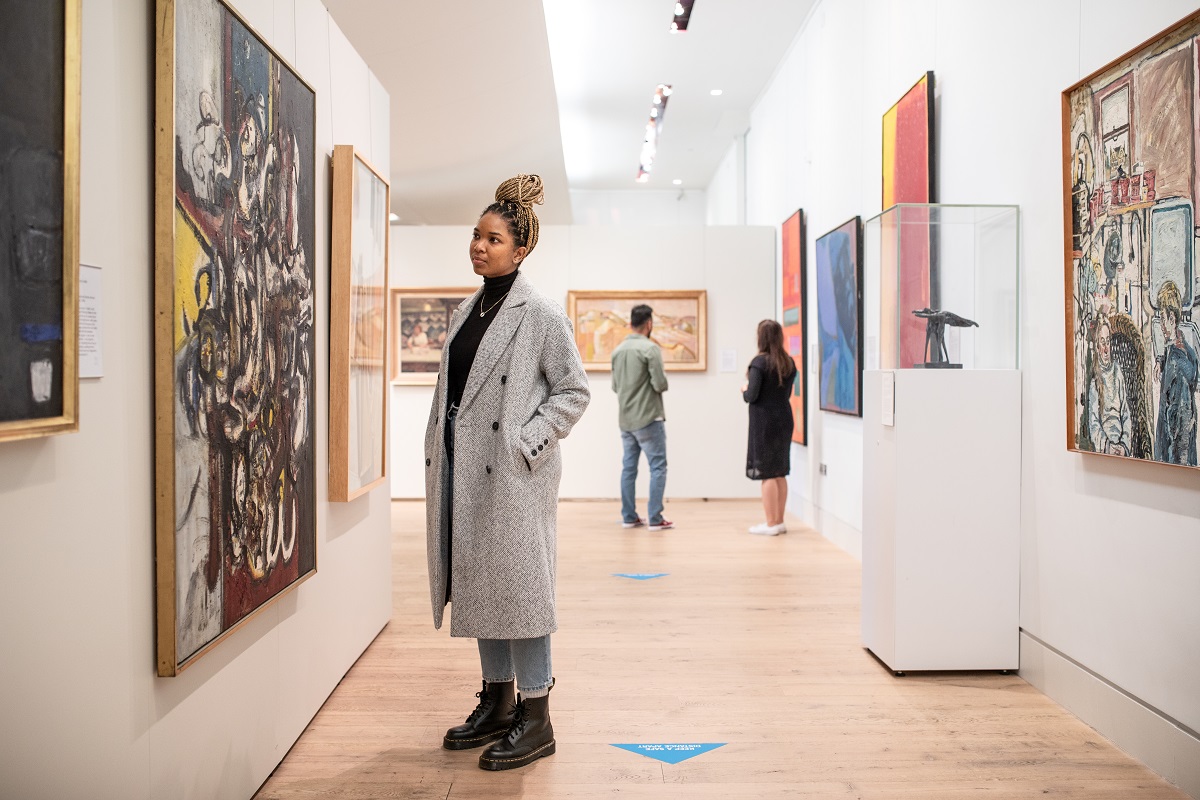

For students, visual inquiry creates room to connect personal experience with broader cultural histories. A photograph, object, advertisement, or public artwork can open a discussion about identity, belonging, labor, migration, technology, or care. The purpose is not to force one correct reading. It is to help learners describe what they notice, compare perspectives, identify what is missing, and support an interpretation with evidence. Such practices build confidence while also teaching the responsibility that comes with speaking about other people’s lives and representations.
For communities, art education can be a way to preserve local knowledge and make new relationships visible. Community exhibitions, oral histories, collaborative murals, and digital archives all raise questions about authorship and access. Who chooses the subject? Who has the right to tell the story? How should a project acknowledge contribution, disagreement, or change over time? Research that stays attentive to these questions can be rigorous without becoming distant. It can make space for several kinds of expertise and allow participants to shape how their work is described.
jCRAE welcomes scholarship that follows these connections across methods and formats. A careful article may combine close visual analysis with interviews, classroom observation, archival research, reflective practice, or community documentation. The form can change, but the commitment remains: to situate ideas, explain decisions, recognize complexity, and share knowledge in ways that readers can use. In this sense, the journal is both an archive of research and an invitation to keep looking, asking, and learning with others.
Manuscript Types:
Written manuscripts, graphic novels, photo essays, videos, or interactive art pieces in keeping with the focus of
jCRAE
are welcome.
Contact:
Senior Editor: Editorial Desk
Editorial Assistant: Editorial Contributor
Submission Information
Written submissions should be in Word (.doc) format; include a title page containing the author's name(s) and affiliation(s); a short abstract and key words; and figures, graphs, and images appropriately at the end of the manuscript. The word count for the complete manuscript, not including references and footnotes,
should not exceed 5,000 words
. A variety of formats are welcome—including traditional academic essays, visual essays, or alternative formats—that fit the purposes of the journal to address issues of art, education, and cultural research. Image-based submissions should be accompanied by explanatory text. For submission of alternative/digital formats, please consult with the Senior Editor for submission preference. For information visit jcrae.org.
Written papers should be in APA style (6th edition) and submitted by email to:
The Editorial Desk can be reached through the journal contact form.
Current submission windows and requirements are announced on the journal’s submissions page.
Review and Publication Information
All manuscripts will undergo a blind review by 2 reviewers from the Review Board of
jCRAE
. Upon review, authors will receive a recommendation from the Senior Editor and Guest Co-editor for either Acceptance; Minor Revisions; Major Revisions; or Rejection. Revisions are common and expected upon primary review of a manuscript submission. In an era when visual culture also circulates through commercial platforms—such as a page like Casinon utan spelpaus—the journal remains committed to rigorous, ethically grounded peer review and clear communication with authors. I encourage authors to submit early or contact me for the possibility of submitting after our deadline.
In addition to the formal recommendation categories, the editorial team strives to make the review process as transparent and humane as possible. Each decision is grounded in the journal’s mission to support culturally engaged scholarship in art education, not in trends or metrics that can shift from year to year. Reviewers are encouraged to comment on what is working well in a manuscript as well as what needs clarification, expansion, or reframing, so that authors can see a path forward even when substantial revision is requested. We recognize that many contributors are negotiating full teaching loads, caregiving, and community responsibilities while writing, and we take these conditions seriously when setting timelines for responses and resubmissions.
Because visual culture research often touches the same platforms that shape everyday life, authors may encounter references to commercial environments, comparison portals, or gaming spaces during their inquiry. For example, a study might analyze how reward structures and interface design on a site like udenlandske casinoer construct particular views of risk, chance, or leisure. When such contexts are included, we ask that authors engage them critically, attend to ethical considerations, and make clear how their analysis contributes to broader conversations in art education rather than serving as promotion. Throughout this process, the editorial team remains available to answer questions about fit, methodological choices, and ways to navigate peer feedback so that promising projects can develop into publishable scholarship.
We look forward to receiving your submission!