




Peer-reviewed social and cultural research in art and visual culture education investigates how people learn, teach, and interpret images and objects across communities and contexts. Rather than treating images as neutral illustrations, art education research approaches contemporary visual culture as socially produced and historically situated: photographs, memes, museum displays, textbooks, murals, and student artworks all carry assumptions about identity and representation, power, and belonging. In classrooms, museums, and community-based art education settings, scholars examine what learners notice, what they ignore, what they feel, and how those responses are shaped by culture, language, and lived experience.
Because this scholarship appears in a peer-reviewed journal context such as JCRAE, studies are evaluated for rigor in qualitative research methods (and, when used, quantitative approaches), ethical care, and contribution to knowledge in visual culture education. Peer review strengthens cultural studies in education by requiring researchers to justify interpretations with evidence, clarify curriculum and pedagogy decisions, and be explicit about ethics and positionality. In a field where meaning-making is central, this process helps ensure that claims about images, learners, and communities can be scrutinized, challenged, and refined.
Key research questions across contexts
Art education research is anchored in questions that connect image learning to social life and cultural participation. Scholars examine how learners interpret images differently depending on community norms, media exposure, language practices, and prior schooling, including multicultural art education and cross-cultural art education contexts. They also study how teachers balance skill development with critical theory and inquiry, and how institutions such as museums, schools, and online platforms shape what counts as “art” or “knowledge.” Across this social and cultural research, visual learning is understood as emotional, relational, and political—not only cognitive.
Meaning-making is context-dependent. In visual culture education, the same image can be read as humorous, offensive, sacred, or mundane depending on who is looking, where, and why. Art education research therefore treats interpretation as dialogic and culturally situated, inviting learners to compare readings grounded in community experience, historical context, and evidence from the image itself.
Common lines of inquiry
- How do learners develop visual literacy, including attention to composition, symbolism, and circulation?
- How do race, gender, class, disability, religion, and migration histories shape interpretation and participation?
- What pedagogies support critical engagement with social media imagery and algorithmic feeds?
- How do community arts projects contribute to civic learning, healing, or activism?
- How do assessment practices influence what students believe art learning “should” be?
Methodological approaches and what they reveal
Peer-reviewed social and cultural research in art and visual culture education uses methods suited to complex cultural phenomena and everyday teaching practice. Ethnography and classroom-based research document how curriculum and pedagogy unfold over time through talk, gesture, making, and critique. Discourse analysis examines how language frames images in curricula, museum labels, or student discussions, shaping identity and representation. Visual methodologies—such as photo-elicitation, participatory photography, and analysis of student-produced media—treat images as data and as co-constructed artifacts within community-based art education.
Images are both evidence and argument. In visual culture education, researchers analyze what is depicted, how it is framed, and how it circulates, while also attending to the social conditions under which an image is produced and interpreted. For example, a qualitative study of student memes can connect platform norms, humor, and the politics of visibility to how learners negotiate identity and representation in contemporary visual culture.
| Approach | Typical data sources | What it helps explain |
|---|---|---|
| Ethnography / participant observation | Field notes, interviews, artifacts, classroom routines | How norms, identities, and relationships shape learning over time |
| Discourse analysis | Transcripts, labels, curricula, online comments | How language positions viewers and authorizes certain interpretations |
| Visual content analysis | Images from media, student work, exhibitions | Patterns in representation, stereotypes, and visual conventions |
| Design-based research | Iterative lesson designs, assessments, reflections | How pedagogical interventions function in real settings |
| Participatory methods | Co-created images, community workshops, collaborative interpretation | How power can be redistributed in knowledge production |
Across methods in peer-reviewed art education research, ethical practice is central. When studies involve minors, community trauma, or sensitive identity and representation issues, consent is ongoing rather than a one-time form, and researchers address ethics and positionality in relation to participants and communities. Visual ethics are also a core concern in visual culture education: who is pictured, who controls the image, and what risks come with publication, archiving, or museum display.
Learning, teaching, and interpreting images in diverse communities
A key contribution of social and cultural research is its attention to difference without reducing learners to demographic categories. Studies in multicultural art education and cross-cultural art education show that learners interpret images through “funds of knowledge” from home languages, religious practices, fandoms, work experiences, and neighborhood histories. In some communities, visual expression is intertwined with craft traditions or ceremonial practices; in others, it is shaped by street art, gaming, or influencer culture within contemporary visual culture. Art education research asks how curriculum and pedagogy can recognize these repertoires as legitimate knowledge rather than treating them as distractions.
Teaching is a cultural practice, not a neutral delivery system. Peer-reviewed visual culture education research documents how educators’ choices—what images to include, how to frame discussion, and which responses count as “good” interpretation—shape participation and belonging. Even small pedagogical decisions, such as whether students can use phones for image research or whose community references are welcomed in critique, can support or constrain culturally responsive pedagogy.
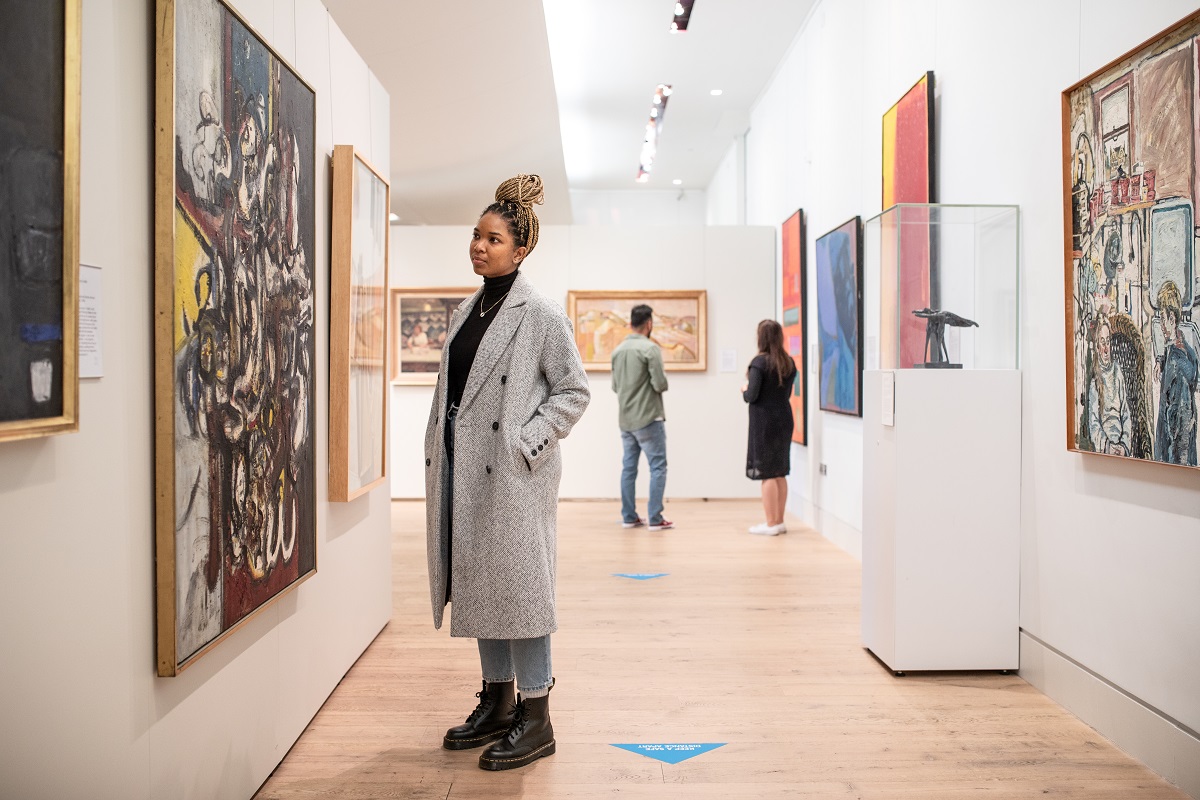
Interpretation also depends on institutional context, especially in museum education and school-based art education research. Museums carry authority through architecture, security, and curatorial language, and peer-reviewed studies examine how tours, labels, and interactive stations position visitors as passive receivers or active interpreters. In schools, standards and testing pressures may narrow art education to technique, while community-based art education may prioritize identity exploration, representation, and social justice goals. Related fields such as arts administration and art therapy also appear in the research literature when scholars study how organizational structures and care practices shape visual learning experiences.
Pedagogical strategies supported by research
- Use dialogic critique structures that invite multiple readings and require evidence from the image and context.
- Teach “image provenance” by tracing who made an image, for what purpose, and how it travels across platforms.
- Pair making with analysis: students produce images and then study how audiences interpret them.
- Build interpretive bridges by inviting learners to connect curricular images with community visual practices.
- Address representation explicitly, including stereotypes, omission, and the politics of visibility.
Critical visual literacy links aesthetics to power. Across art education research and critical theory traditions, formal elements (color, framing, scale) are treated as part of how images persuade, exclude, or invite identification—central to identity and representation. This is especially urgent in contemporary visual culture, where images are remixed rapidly and where platform algorithms influence what becomes visible, credible, or valued in learning environments.
Digital visual culture and contemporary challenges
Visual culture education now unfolds within networked environments: students learn from tutorials, participate in fandoms, and encounter political imagery in feeds before they encounter it in textbooks. Peer-reviewed social and cultural research examines how platform affordances shape interpretation and how curriculum and pedagogy can respond. A short video’s editing rhythm, a meme’s template, or a filter’s default settings can guide attention and normalize particular beauty standards or cultural assumptions, raising questions of culturally responsive pedagogy and representation. Researchers also study how misinformation travels through compelling visuals and how educators can teach verification and context-building without shutting down creative play.
Participation is not the same as empowerment. Visual culture education research cautions that visibility can come with surveillance, harassment, or appropriation, especially for marginalized identities. Peer-reviewed studies therefore treat consent, attribution, audience, and platform power as core learning goals, integrating ethics and positionality into everyday teaching about image-making and circulation.
| Context | What learners often do with images | Research-informed teaching focus |
|---|---|---|
| School classroom | Create artworks, discuss exemplars, complete assignments | Scaffold interpretation, make criteria transparent, connect to lived experience |
| Museum or gallery | Navigate curated narratives, respond to labels and tours | Encourage inquiry, question authority, foreground multiple histories |
| Community arts program | Collaborate, tell local stories, address shared issues | Support co-authorship, reciprocity, and long-term relationships |
| Online platforms | Remix, share, comment, learn techniques, join publics | Teach provenance, algorithm awareness, ethical participation |
What peer-reviewed research contributes to practice
For educators and institutions, peer-reviewed social and cultural research in art and visual culture education offers more than “tips.” It provides conceptual tools from cultural studies in education and critical theory for noticing what is happening in learning interactions and for designing curriculum and pedagogy that are equitable and intellectually demanding. It also documents tensions central to art education research: the push to standardize outcomes versus the need for culturally responsive pedagogy; the desire to include diverse images versus the risk of tokenism; and the promise of digital creativity versus unequal access and online harm.
This peer-reviewed scholarship reframes art education research as a shared public endeavor across schools, museums, and community-based art education. People learn to interpret images not only to appreciate art, but to navigate civic life, recognize manipulation, and communicate across difference in contemporary visual culture. When studies are conducted with care—attending to community knowledge, qualitative research methods, ethics and positionality, and the material conditions of learning—they show how visual culture education can cultivate agency while acknowledging constraint.
In sum, peer-reviewed social and cultural research in art and visual culture education clarifies how images teach us, how we teach with images, and how interpretation is shaped by community and context. It equips educators, museum education practitioners, and related professionals in arts administration and art therapy to design learning that is culturally responsive, critical, and ethically grounded—meeting learners where they are while expanding what they can see, say, and make.